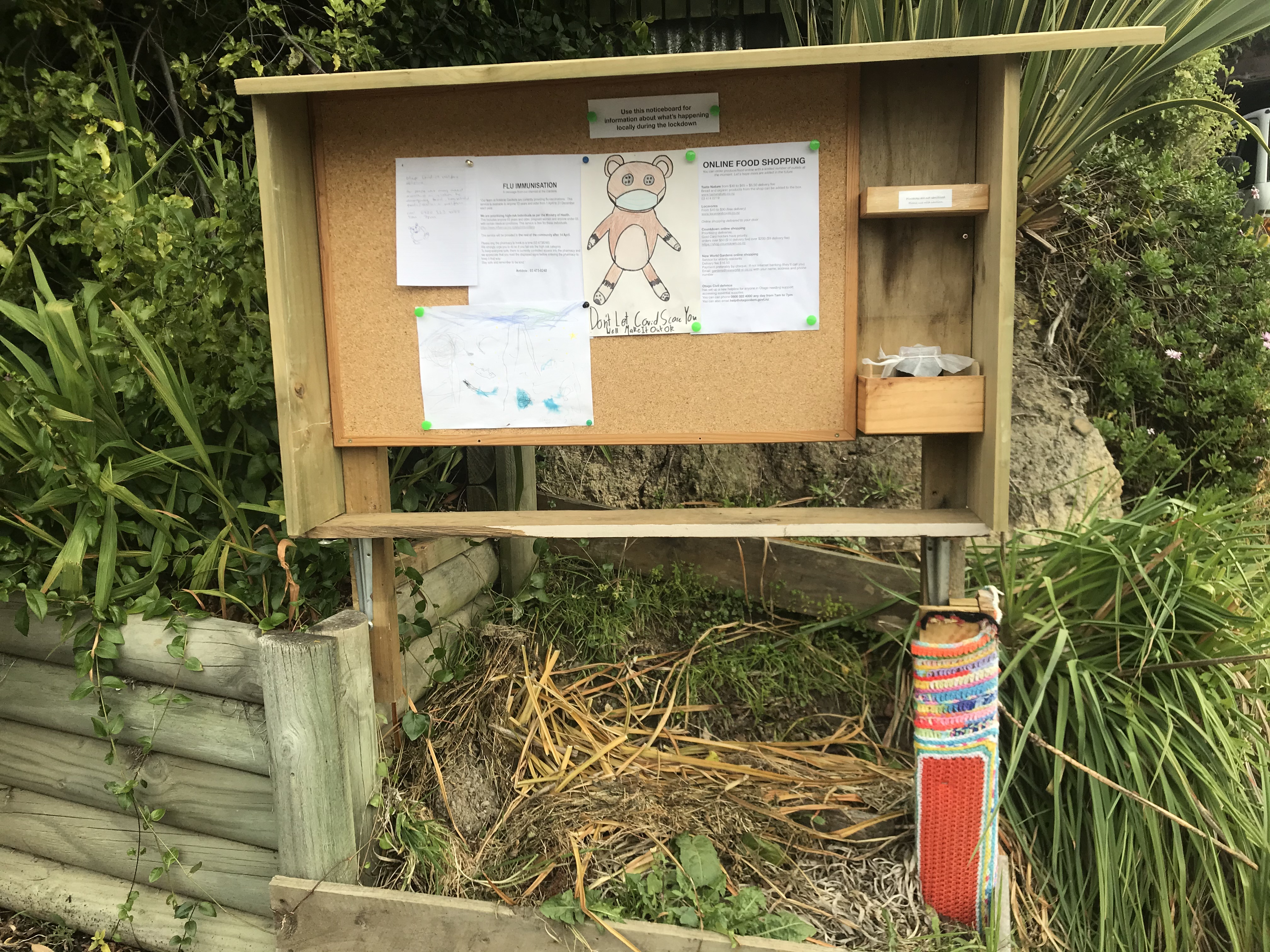
Walk through almost any established Canadian neighbourhood — whether it's a mid-century suburb in Mississauga, an older residential block in Halifax's North End, or a mixed-use corridor in Winnipeg's Osborne Village — and you will find at least one physical bulletin board. It might be weather-beaten plywood mounted to a hydro pole. It might be a glass-fronted case at the entrance to a community centre. In either form, it collects information that no single authority produces and no algorithm curates: a notice about a missing dog, a rental listing, a handwritten flyer for a yard sale, a photocopied reminder about an upcoming BIA meeting.
These boards have existed in Canadian communities for well over a century. They predate local newspapers, predate radio, and have outlasted several generations of competing communication formats. Understanding why they persist — and how they actually function — requires looking at what they do that other channels don't.
What gets posted, and why it matters
Community notice boards carry a category of information that sits between the purely personal and the officially institutional. Municipal government communicates through its own channels: the city website, local councillor newsletters, planning application signage. Neighbourhood Facebook groups and Nextdoor boards carry real-time conversation but require accounts, internet access, and active participation. Physical bulletin boards sit outside both of those systems.
According to research from Statistics Canada, roughly 14 percent of Canadian adults do not use the internet at home, with rates significantly higher among adults over 65 and in lower-income households. For these residents, a physical board at a laundromat or grocery store is not a backup channel — it's the primary one.
The content on Canadian community boards tends to cluster around a few recurring categories:
- Housing and rentals — particularly in cities with competitive rental markets, handwritten "For Rent" cards on community boards often carry listings that never appear online
- Local services — lawn care, snow removal, childcare, tutoring, and pet sitting offered by residents rather than registered businesses
- Lost and found — pets, wallets, keys, bikes, and occasionally children's belongings posted by residents with no other efficient way to reach neighbours
- Community events — farmers market dates, community garden workdays, block association meetings, and school fundraisers
- Civic notices — some municipalities use public boards as a supplementary posting location for planning notices, particularly in neighbourhoods with older demographic profiles
Who manages community notice boards
Management varies considerably depending on the board's location. Boards inside community centres and libraries are typically maintained by staff, with posted materials reviewed on a weekly or monthly schedule. Outdoors boards on public property fall under municipal jurisdiction, with rules varying by city.
In Toronto, the City of Toronto's Street Works By-law limits posters on utility poles to specific dimensions (28 × 43 cm) and requires they be removed within 30 days of posting. Violations can result in fines, though enforcement is inconsistent. Vancouver's neighbourhood houses — a network of community centres with deep roots in the city's social infrastructure — maintain boards with rotating content reviewed by community coordinators. Calgary's parks and recreation facilities provide dedicated indoor posting space that is cleared on a predictable monthly schedule.
In smaller municipalities, management is often informal. A local business owner tacks up a corkboard near the front door and lets customers add whatever they like. Residents in the immediate area develop an informal understanding of the space without any written policy governing it.
The maintenance question
The quality of a community notice board is closely tied to the consistency of its maintenance. Boards that go uncleaned accumulate outdated information rapidly — a notice about an event from eight months ago crowds out a current posting about a neighbourhood safety concern. In some cases, an unmaintained board signals community disinvestment rather than community activity, and residents stop consulting it.
Community organizations that manage boards well tend to share a few characteristics. They designate a specific person responsible for weekly review. They apply a consistent removal policy — typically anything older than 30 or 60 days comes down regardless of content. They keep the board visually accessible, which often means limiting the number of postings visible at any given time rather than allowing unlimited stacking.
The Business Improvement Areas of Ontario documentation on community engagement notes that managed boards with clear maintenance schedules see roughly three to four times the use of unmanaged boards in similar locations — measured both by posting frequency and by resident consultations.
Bylaw differences across Canadian cities
Any resident or community organization thinking carefully about notice board use in Canada has to reckon with the patchwork of municipal bylaws that govern public posting. A few notable contrasts:
- Ottawa distinguishes between "community information boards" maintained by the city's recreation department and informal boards on private property, with different rules governing each
- Edmonton permits posting on utility poles only in designated communities and only through a permit obtained from the city's communications office
- Victoria allows posting at designated kiosk locations near transit hubs with no permit requirement but a 14-day maximum display period
- Québec City arrondissements set their own posting guidelines, meaning rules in Limoilou differ from rules in Sainte-Foy–Sillery–Cap-Rouge
These differences mean that practices normal in one city can result in fines in another. Residents who move between Canadian cities often discover local posting norms only after their first violation notice.
What makes a board useful versus decorative
Not every community board functions as a communication channel. Some are placed in high-traffic locations but maintained so poorly that residents have stopped checking them. Others sit in low-traffic hallways that see little foot traffic from the residents most likely to benefit from the information posted there.
Location matters significantly. Boards placed at eye level near building entrances, transit stops, or the entrances to well-used community spaces see the most engagement. Indoor boards near mailbox areas in apartment buildings tend to outperform boards in lobbies where residents pass quickly. Boards with transparent covers that protect from rain while keeping content visible perform better than open boards in rainy climates like Vancouver or Halifax.
The content mix also affects use. A board dominated by commercial advertising — pest control flyers, real estate agent cards — crowds out the hyperlocal resident-generated content that gives a community board its distinct value. Effective board management usually involves some editorial judgment about what stays and what comes down.
The relationship between physical boards and digital channels
Physical notice boards and digital neighbourhood channels are not in direct competition. They reach different people at different moments and serve overlapping but distinct communication needs. A resident scrolling through a neighbourhood Facebook group at 11 pm on a Tuesday is receiving information in a fundamentally different context than someone stopping to read a notice board while walking home from the bus stop.
Some Canadian community organizations have found value in running both: maintaining a physical board for residents who engage with that format, while mirroring the most time-sensitive notices on a neighbourhood Facebook group or email list. The physical board then serves as a stable reference point that doesn't disappear into a feed after 24 hours.
For residents without internet access, the physical board is not a supplement. It is the whole system. That reality shapes how community organizations with genuine reach across different resident demographics think about where to invest maintenance resources.
Further reading on local information networks: Hyperlocal Information Networks: Why Physical Boards Still Matter